
CH582/CH583 BLE+USB MCU
CH582/CH583 are RISC-V BLE wireless MCUs from Nanjing Qinheng Microelectronics (WCH), integrating a Bluetooth Low Energy protocol stack and two independent USB 2.0 full-speed Host/Device controllers with PHY. Both offer 512 KB Flash, 32 KB SRAM, four UARTs, ADC, TouchKey, RTC, and related peripherals. CH583 adds SPI1 master mode and supports a lower minimum supply (1.7 V) versus CH582.
The series also includes CH581 (256 KB Flash, single USB, reduced peripherals). This page focuses on CH582/CH583.
Core Specifications
| Item | Specification |
|---|---|
| Product type | RISC-V BLE wireless MCU (dual USB) |
| Core | QingKe RISC-V4A; RV32IMAC; hardware multiply/divide |
| Flash | 512 KB FlashROM (448 KB CodeFlash + BootLoader + DataFlash partitions) |
| SRAM | 32 KB (RAM30K / RAM2K retention regions) |
| Wireless | BLE; 2.4 GHz RF; 2M / 1M / 500k / 125k; -98 dBm RX sensitivity; programmable TX up to +6 dBm |
| USB | 2× USB 2.0 full-speed Host/Device; 15 endpoints each; DMA; 64-byte packets; integrated PHY |
| Analog | 14× 12-bit ADC + 2 internal channels; 14× TouchKey; on-chip temperature sensor |
| Interfaces | 4× UART (up to ~6 Mbps); 2× SPI (CH583 includes SPI1 master); 1× I2C (SMBus) |
| Timers / PWM | 4× 26-bit timers; 4× 26-bit PWM + 8× 8-bit PWM |
| GPIO | Up to 40 (20 on small packages); 32 interrupt/wake lines; some pins accept 5 V input |
| RTC | Timing and trigger modes |
| Security | AES-128; unique chip ID |
| Upgrade | ICP / ISP / IAP and OTA wireless update |
| Packages | QFN48 (5 mm × 5 mm), QFN28 (4 mm × 4 mm) |
Part Differences (Selection Summary)
| Part | Flash layout | BLE | USB | SPI | I2C | TouchKey | Min supply | GPIO | Package |
|---|---|---|---|---|---|---|---|---|---|
| CH583M | 448+24+32K | Yes | 2 Host + 2 Device | 2 (incl. SPI1 master) | Yes | 14 ch. | 1.7 V | 40 | QFN48 |
| CH582M | 448+24+32K | Yes | 2 Host + 2 Device | SPI0 master/slave | Yes | 14 ch. | 2.3 V | 40 | QFN48 |
| CH582F | 448+24+32K | Yes | 2 Host + 2 Device | SPI0 master/slave | Yes | 8 ch. | 2.3 V | 20 | QFN28 |
Summarized from the CH583/CH582/CH581 datasheet. The CH583 product page lists BLE 5.3; some datasheet revisions reference BLE 5.0—confirm with your SDK/stack version.
CH582 vs CH583
- CH583: adds SPI1 master; CH583M minimum supply down to 1.7 V (also supports 1.8 V options).
- CH582: 2.3 V minimum; CH582M (QFN48) or CH582F (QFN28, fewer GPIO/TouchKey).
- Both integrate dual full-speed USB and a full BLE stack/API for USB + Bluetooth composite devices.
Block Diagram
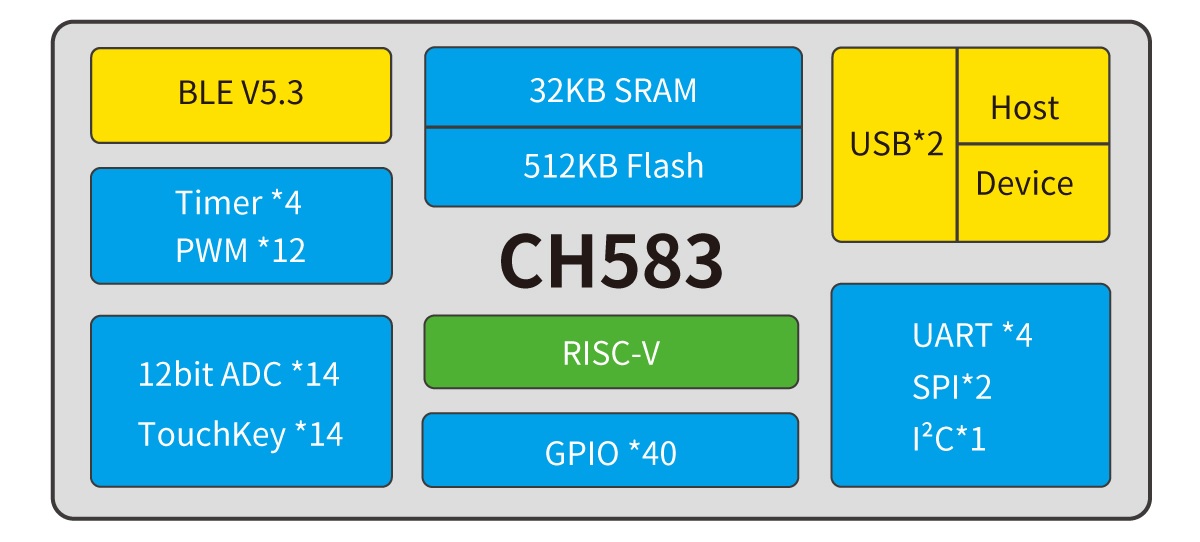
Architecture of the Qingke RISC-V core, Flash/SRAM, BLE baseband/RF, dual USB, ADC/TouchKey, and peripherals (image source: openwch/ch583).
Key Features
- Single-chip BLE + dual USB without external USB PHY—suited to HID, CDC, MSD, composites, and BLE gateways.
- 512 KB Flash for stack and application code with OTA support.
- 14 ADC channels and TouchKey for sensors and low-power HMI.
- Integrated DC-DC and multiple sleep/shutdown tiers (sleep roughly 0.7–2.8 µA class per datasheet).
Typical Applications
- BLE transparent links, beacons, remotes, and IoT endpoints
- USB + Bluetooth dual-mode dongles, keyboards, mice, custom HID
- Dual-USB products (e.g., Type-A + Type-C composite functions)
- Battery-powered wearables/portables (CH583M low-voltage advantage)
Design Notes
- Supply: CH583M down to 1.7 V; CH582 requires 2.3 V minimum—match part and battery profile.
- Debug: SWD typically PB14/PB15; first WCH-Link use may require enabling 2-wire debug via WCHISPTool (hold Download entering BOOT).
- CH581: evaluate CH581 if single USB or 256 KB Flash is sufficient.
- Development: MounRiver Studio, openwch/ch583 SDK, and EVB materials.
References
- WCH CH583 product page (Chinese)
- WCH CH583 product page (English)
- CH583/CH582/CH581 datasheet PDF
- openwch/ch583 SDK and examples
- USB series
- Other model summary
Notes
This page is based on the WCH CH583 official product page and the public CH583/CH582/CH581 datasheet. Confirm part-specific differences, pinout, RF/USB coexistence, and production support with the latest vendor documentation, SDK, and project validation.