
MS1827-Based 5.5-Inch HD Screen Video Switcher Design
UltraSemi is designing a compact video switcher based on the MacroSilicon MS1827 for small live production, meeting recording, education, training, and event switching scenarios. The concept focuses on multi-source video input, built-in preview, quick switching, and lightweight operation in a desktop-friendly form factor.
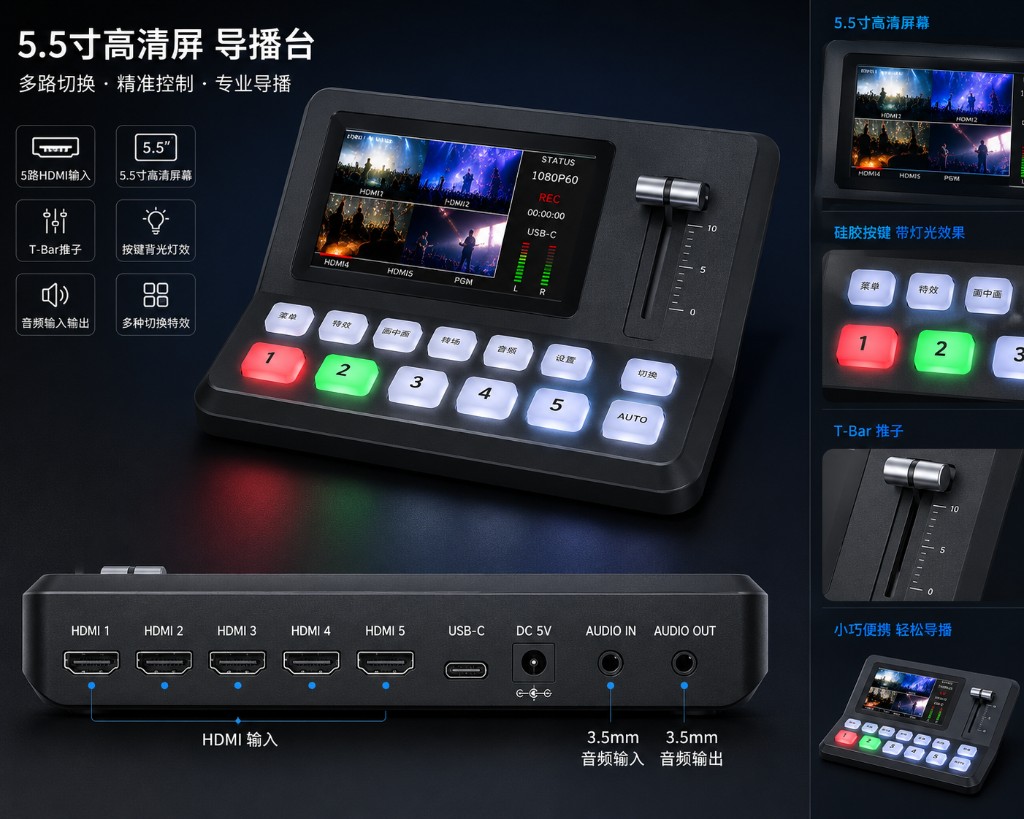
Product Positioning
Traditional multi-camera production often requires a video switcher, monitor, audio equipment, and multiple cables. For mobile live streaming, small meeting rooms, and desktop content creation, this setup can be costly, slow to deploy, and difficult for non-specialist users.
This design aims to consolidate common switching functions into one compact device:
- Multi-channel HD signal input for cameras, PCs, media players, and other common sources.
- Integrated 5.5-inch HD screen for multiview preview and program monitoring.
- Physical keys, touchscreen menus, and a T-Bar for switching, effects, and manual transitions.
- Audio input and output interfaces for microphones, mixers, or external monitoring devices.
- Compact mechanical design for desktop use, field production, and temporary event deployment.
Role of MS1827
MS1827 is a video processing IC suited for multi-channel video input, image processing, switching control, and output path management. In this switcher design, it can serve as the core video processor connecting HD inputs, the preview display, program output, and peripheral control logic.
The development focus around MS1827 is not only interface count, but also the integration of input detection, frame synchronization, transition effects, OSD status display, and responsive control. For a switcher product, low latency, stable synchronization, and consistent key response directly affect live operation, so hardware design, firmware strategy, and user interaction need to be considered together.
Planned Features
Multi-Channel HD Input
The current industrial design reserves five HD input ports, covering typical sources such as multi-camera setups, presentation PCs, media players, and backup inputs. Front-panel keys map to input sources so operators can select feeds quickly.
During later design validation, the HD input section should focus on EDID strategy, hot-plug detection, resolution compatibility, and recovery from abnormal signals, ensuring fast restoration after equipment replacement or recabling.
5.5-Inch HD Preview Screen
The built-in 5.5-inch HD screen can show multiple input previews, the current program output, recording status, output resolution, audio levels, and interface status. Compared with relying only on an external monitor, an integrated screen reduces setup cost and makes the device better suited for mobile scenarios.
The touchscreen can handle menu settings, effect selection, and audio status viewing, while physical keys cover high-frequency switching actions. This combination balances intuitive operation with reliability.
T-Bar and Transition Effects
The switcher keeps a T-Bar for manually controlling transition progress. Compared with a single key press, a T-Bar is better suited for stage events, course recording, and multi-camera interviews where transition timing matters.
The design also includes dedicated function keys for menu, effects, picture-in-picture, mute, settings, switching, and auto transition. Future firmware can provide shortcut mapping around common workflows to reduce deep menu operations.
Audio Input and Output
The interface area reserves 3.5mm audio input and 3.5mm audio output for external audio sources, microphone preamps, or monitoring equipment. For live production devices, audio status feedback is also important; on-screen left and right channel meters help operators quickly check signal status.
Design-Stage Validation Points
This switcher is still in the design stage. Follow-up prototype validation should focus on:
- Video path: multi-input switching stability, resolution compatibility, end-to-end latency, and abnormal signal recovery.
- User interaction: key feel, illuminated key state definitions, T-Bar damping, touchscreen menu hierarchy, and protection against accidental operation.
- Thermal and power design: chip temperature under long operation, enclosure heat dissipation path, and USB-C / DC 5V power margin.
- Mechanical reliability: HD port insertion durability, T-Bar life, key life, and screen protection structure.
- Firmware upgrade: upgrade path for feature iteration, parameter tuning, and field issue fixes.
Typical Applications
This type of compact switcher is suitable for scenarios sensitive to space, cost, and operation complexity, such as corporate live rooms, training classrooms, small meeting rooms, church events, exhibition demos, sports commentary, and outdoor mobile live streaming. For users who need 1080P-level switching, preview, and fast source selection, it can reduce peripheral equipment and simplify setup.
Summary
The MS1827-based 5.5-inch HD screen switcher concept brings multi-channel input, preview display, physical switching controls, and audio status into one portable device. As hardware prototypes, firmware features, and mechanical details are validated, this design can become a cost-effective option for small live production and lightweight switching applications.
Final functions, interface definitions, and performance should be based on prototype test results and mass-production specifications.